Showing posts with label Rescues. Show all posts

Friday, January 15, 2010

Not-so-injured Western Screech-Owl

The phone rang late two nights ago. It was David B., one of our avian caretakers, who had driven right over a lump in the road, realizing at the last minute that it was an injured owl. He stopped, gathered up the bird, and was anxious to get medical care for the stunned owl. As I set about making calls to find the nearest person, he called back again. This time he reported that he didn't think there was anything wrong with this owl. Apparently when he got the owl home and was attempting to put it into a box, the owl wriggled free and led David on a merry chase throughout his house. Still, I knew that the owl would need to be examined by a wildlife rehabilitator prior to release to ensure there were no underlying problems. David and owl arrived at my home about an hour later, with the little screecher secured in a well-taped cardboard box.

All was well until about 5:30 a.m., when I gathered up little owl, huddled in the corner of his box to give life nourishing fluids. Same scenario: owl wriggles free, flies all over my house, and finally gets chased into the bathroom (where the kestrel sleeps at night). Whew! Owl seems fine to me too, but I know the drill. It's off to a rehabilitator for a better evaluation.

So, yesterday, I took little owl to the office where Kristin and Peggy are both wildlife rehabilitators (I am only an emergency back-up for the real thing - sort of like a bird EMT). Kristin drew the short straw and took Little Owl out of the carrier for evaluation. A strong sense of deja vu came over me. Sure enough, Little Owl wriggled free and was free-flying in our office, at one point perching atop the coat tree right in front of the photo of our educational screecher. Ron K. snapped this photo, and then it was off again. Did you know that a screecher can hang upside down from the ceiling tiles? Fortunately, we have large nets in our office for the precise purpose of catching injured birds.

In the case of Little Owl, the odds are excellent for release, probably within a day or two. However, it does graphically illustrate the power of an observant human. Had David not come upon Little Owl at that precise moment, the next car may have created road kill instead of saving a life! Thank you David!

Tuesday, September 16, 2008

Bathtub Bird


Early Monday morning we got the call. A woman in Los Lunas had a bird in her bathtub (No water). Could Hawks Aloft come get it? The first thing to establish: was it a hawk?

We have a series of questions we ask to determine, as closely as possible, what type of winged creature a member of the public has. This person was adamant she had a small hawk, probably a Kestrel. Transporting and handling a raptor usually takes special skills. Before driving an hour to pick up a bird, we ensure it is one of our target species; raptor, corvid, or roadrunner, because anyone can transport a songbird to the Wildlife Rehabilitator.

The next question: was it truly injured? Many fledgling birds, including raptors, are "kidnapped" from the wild each year because well-meaning people pick them up when they are in the awkward "just out of the nest" stage. They will be clumsy fliers for a few days, but their parents continue to care for them. Even trying to watch the bird to determine if it is abandoned will keep the parents away. Right now, it is mostly passed fledgling season. So the little bird was probably not a "brancher" learning to fly. The Los Lunas folks were able to easily scoop up this particular bird with a towel, and the husband proceeded to examine its wings and legs without the bird retaliating (i.e. grabbing him back!). So this bird was probably injured.

Our Raptor Biologist, Ron Kellermueller, found on his arrival that the bird in the bathtub was indeed a hawk - a Sharp-shinned Hawk, smaller relative of the Cooper's Hawk so ubiquitous to the Rio Grande bosque. When he arrived at the office with his feathered charge, we did a quick once over and found no broken bones, but a marked discrepancy in the fleshiness on either side of the keel. Just like our muscles atrophy without use, if a bird has an injury that prevents proper flying, the muscles of the keel will wither from disuse. The one-sided nature of this bird's muscle problem pointed to a possible fracture of the coracoid, a collar-bone like part of a bird's skeletal system. This bone provides muscle attachment for the strong flight muscles of the chest. A fractured coracoid will prevent flight. The good news is, with cage rest and supportive care, this little bird should make a full recovery, and be back to terrorizing songbirds soon!

Thursday, September 11, 2008

Trailer Hawk

During breeding bird season, my job is to arise before the sun to conduct songbird surveys. An 8 hour day usually means I'm headed home by 2 pm. And so it was that hot afternoon in mid-July. My little Toyota was almost through the Tijeras pass when my cell phone rang. An injured hawk was reported in Cedar Crest, not too far from my current location. I did not have a net or box for capture purposes, but I always carry light leather gloves for just such an emergency!


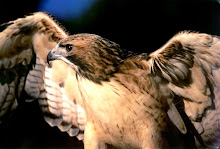
When I arrived, the distraught homeowner pointed out a Red-tailed Hawk perched quietly on her horse trailer. She and her family had been watching the hawks raise a family nearby, and the young ones had recently fledged. The human's joy at this happy event had turned to dismay when they discovered this apparently injured juvenile.


Armed with the knowledge that one of the horses had been nuzzling up to the ruffled raptor, I took the stealth-and-grab-approach. The hawk was no less surprised than the owner when he found himself firmly in hand! A cursory exam revealed no obvious problems, but due to the relative ease of capture and his history of sitting in one spot all day, the decision was made to transport him to a wildlife rehabilitator. The homeowner dredged up a diaper box, which was the perfect fit for the young hawk.


Because I was pretty tired by that point, an office relay was set up for hawk delivery. The office manager met me at a nearby shopping center, and he took the package to the office, where our educator ferried the diaper box (and contents) to the rehabilition facility. I was surprised to learn that the only injury found was a large thorn imbedded in his foot! Once this was removed, he ate like a champ.

I am happy to report that the young Red-tailed Hawk recovered completely, and proved his mouse-catching prowess well enough that he was recently released back into the wild!

Sandy Skeba, photos by Theresa Falzone